
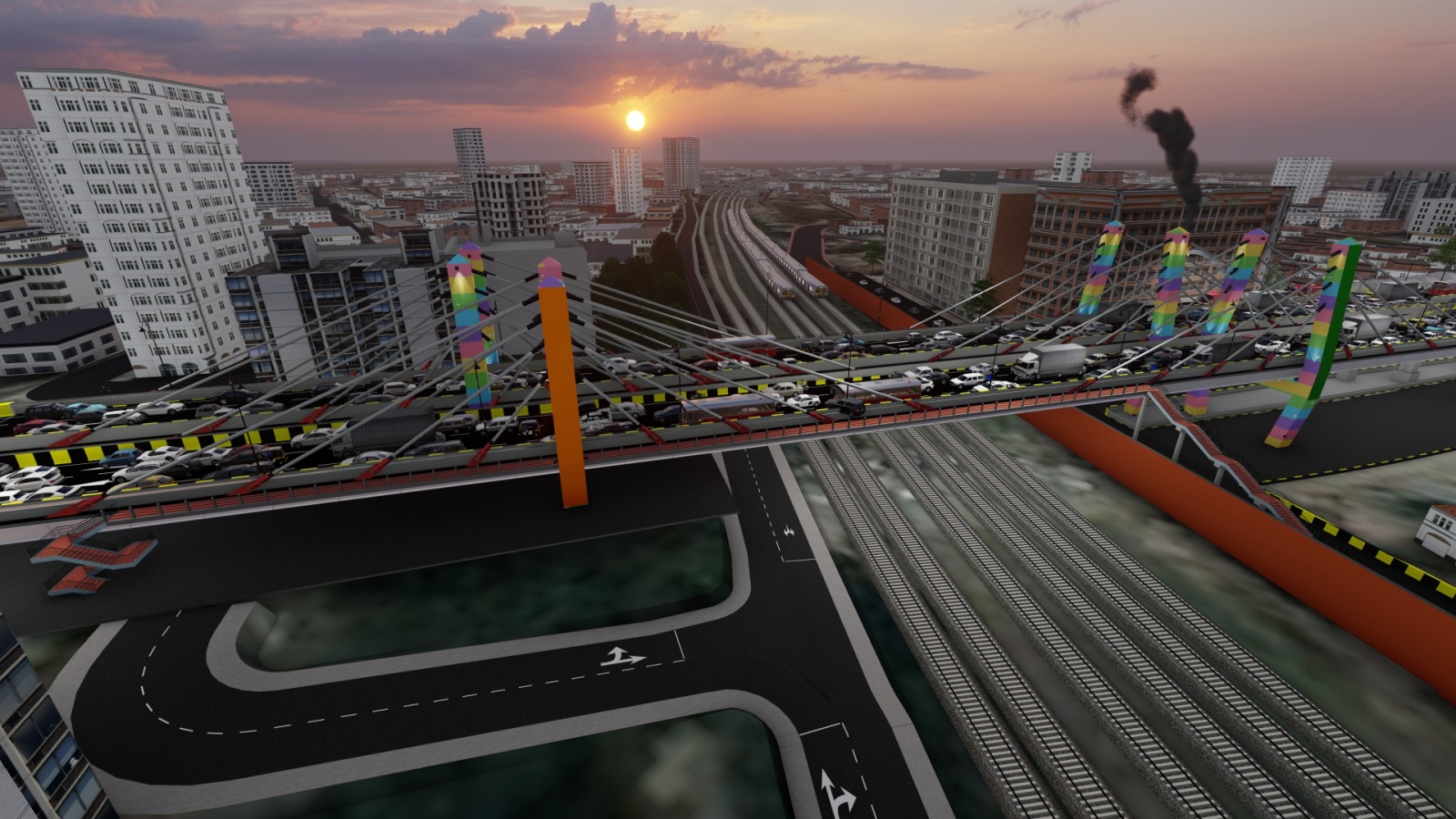
From Dadar to Ghatkopar, four of Mumbai’s busiest traffic bottlenecks are set for a major overhaul over the next two years as new road overbridges come up across suburban railway lines.
Together worth Rs 1,179 crore, the projects are being jointly executed by the Brihanmumbai Municipal Corporation (BMC) and the Maharashtra Rail Infrastructure Development Corporation (MRIDC). Three of the bridges are cable-stayed structures, while the Prabhadevi project will be Mumbai’s first double-decker road overbridge.
The bridges are replacing ageing British-era structures that have become structurally inadequate and can no longer cope with the city’s growing traffic. Designed with wider carriageways and higher load-bearing capacity, the new bridges are expected to improve east-west connectivity and reduce bottlenecks at some of Mumbai’s busiest railway crossings.
The century-old Tilak Bridge, commissioned in 1925, is being replaced with a 600-metre-long cable-stayed bridge featuring six traffic lanes, three times the capacity of the existing two-lane bridge.
Construction is being carried out in two phases. The first three-lane arm is around 70 per cent complete and is expected to open by April 2027. The entire bridge is scheduled to be completed by May 2027.
The century-old Y Bridge is being replaced with a 916-metre cable-stayed bridge designed to improve connectivity along the Byculla-Dadar corridor.
One of the project’s biggest engineering challenges involved launching a 1,500-tonne steel span above the Central Vegetable Market without disrupting market operations or railway traffic.
The bridge is expected to open by December this year and has a dual-carriageway configuration intended to improve traffic flow through one of south Mumbai’s busiest corridors.
A six-lane cable-stayed bridge is under construction along the Andheri-Ghatkopar Link Road across LBS Marg, connecting Ghatkopar East and West.
Built at a cost of Rs 350 crore, it will be the first cable-stayed road bridge in Mumbai’s suburbs. The bridge has been designed with longer spans to minimise supports over the railway corridor, allowing construction while keeping railway operations running.
The project is expected to be completed in 2027 and is aimed at reducing congestion on LBS Marg.
The demolished 112-year-old Elphinstone Bridge is being replaced with Mumbai’s first double-decker road overbridge, which will also form part of the Sewri-Worli Connector.
The lower deck will carry local traffic across the railway tracks, while the upper deck will connect to the upcoming corridor. Each deck will have four traffic lanes, with footpaths on the lower level.
Foundation work and girder assembly are underway, and authorities are targeting completion by November 2026.
Constructing new bridges over one of the world’s busiest suburban railway networks while keeping both trains and road traffic moving has posed significant engineering challenges.
The projects involve launching massive steel segments over live railway lines, extensive night blocks and detailed traffic management coordinated by the BMC, MRIDC, Central Railway, Western Railway, traffic police and utility agencies.
According to MRIDC, cable-stayed designs allow longer spans with fewer supports within railway premises, improving operational safety while reducing future maintenance requirements.
With suburban rail carrying millions of passengers every day and road traffic continuing to grow, the four projects are expected to improve connectivity across some of Mumbai’s busiest rail crossings.