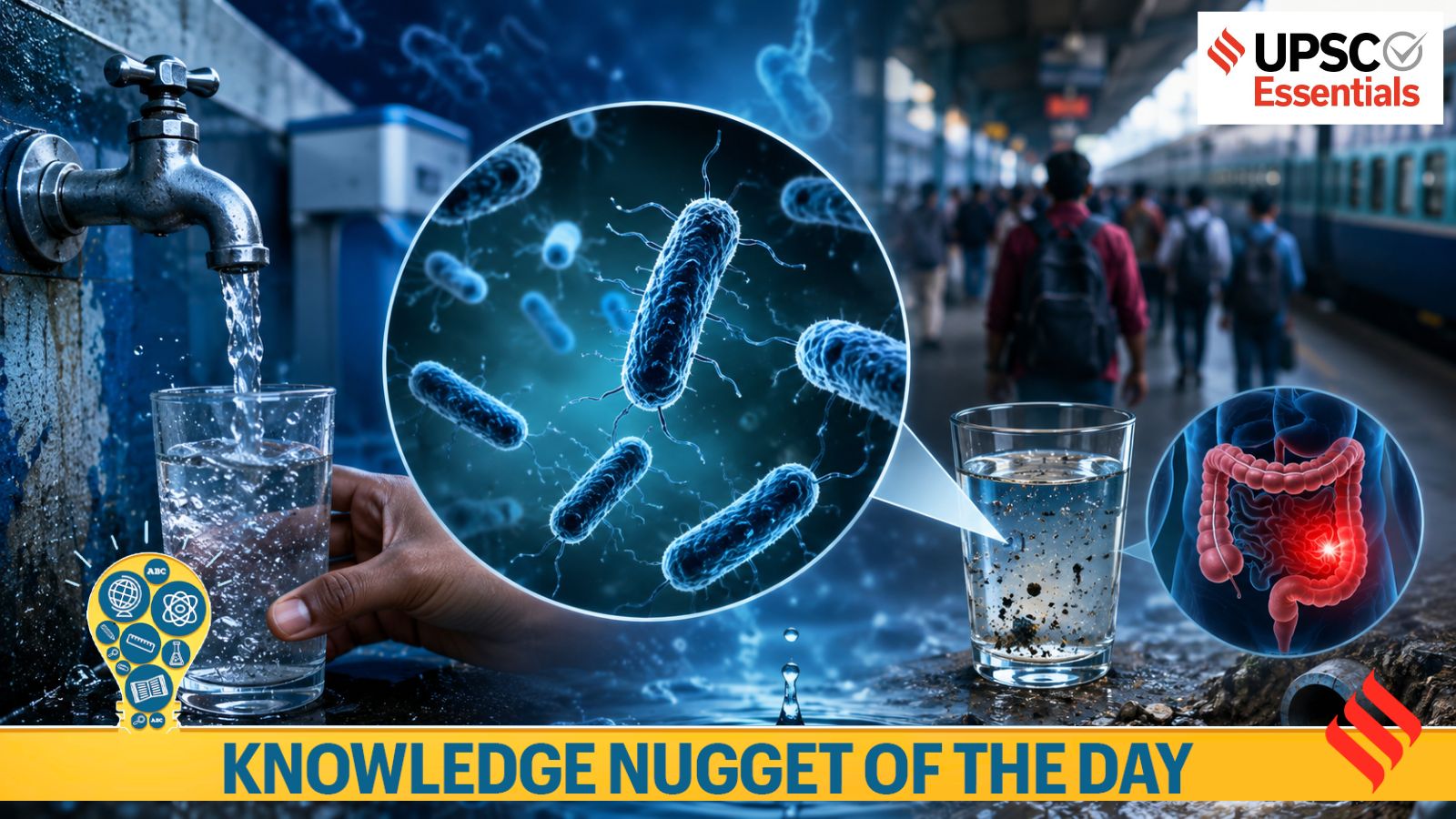
Take a look at the essential events, concepts, terms, quotes, or phenomena every day and brush up your knowledge. Here’s your UPSC Current Affairs knowledge nugget for today on E. coli. The Comptroller and Auditor General (CAG) has flagged violations of water quality norms after E. coli bacteria was found in water samples collected from water coolers at multiple railway stations. The findings have raised concerns about water quality and passenger safety. In this context, let’s know about E. coli in detail. 1. In a recent report titled ‘Passenger Amenities
Take a look at the essential events, concepts, terms, quotes, or phenomena every day and brush up your knowledge. Here’s your UPSC Current Affairs knowledge nugget for today on E. coli.
The Comptroller and Auditor General (CAG) has flagged violations of water quality norms after E. coli bacteria was found in water samples collected from water coolers at multiple railway stations. The findings have raised concerns about water quality and passenger safety. In this context, let’s know about E. coli in detail.
1. In a recent report titled ‘Passenger Amenities and Sanitation at Non-Suburban Railway Stations in Indian Railways’, the CAG said E. coli bacteria was detected in drinking water samples collected from eight railway stations out of 49 stations, including several Mumbai local stations. Other stations were the sample discovered the contamination were those in Kerala, Tamil Nadu, and Jharkhand.
2. The audit also found total coliform bacteria, including E. coli, in drinking water samples collected from platform taps at 49 stations across eight railway zones in 2022-23 and 56 stations across nine zones in 2023-24.
4. Escherichia coli (E.coli) is a bacterial strain that is commonly found in the intestines of people and animals, fecal waste of cattle and humans. The most common manner in which this bacteria contaminates water is if there is a leak in the sewage pipelines in a locality.
5. Unlike other disease-causing bacteria, E. coli can cause an infection even if you ingest only small amounts. So even taking a bite of undercooked or contaminated food or swallowing a mouthful of contaminated pool water can cause an infection.
6. Consumption of water contaminated with E.coli can cause diarrhoea, digestive issues, urinary tract infection and vomiting. The world over, children have been found more vulnerable to diseases caused by this bacteria.
7. Some cause watery diarrhoea, stomach pain and other digestive symptoms. The toxin is so powerful that it can damage the lining of the small intestine, leading to bloody diarrhoea.
8. At times, these bacteria could also travel from the gut to the urinary tract, leading to infections (UTI) there, pelvic inflammatory disease and wound infections.
9. When the E.coli bacteria enters your bloodstream, it provokes an inflammatory response in the body, which can lead to sepsis if injectable antibiotics are not administered in time.
10. Eating contaminated, undercooked or raw food like salads whose vegetables haven’t been washed enough.
11. Drinking contaminated water: E. coli is around us as poop from infected animals and people can contaminate natural water sources and swimming pools. Sharing objects or surfaces with someone with an infection.
12. It is treatable with antibiotics. Unfortunately, some E.coli strains have become drug resistant too because of overuse of antibiotics. A sensitivity test can show which antibiotics can work, whether injectables are required or not.
13. Antimicrobial resistance is a condition in which bacteria, viruses, fungi and parasites no longer respond to antimicrobial medicines, which include antibiotics, antivirals, antifungals and antiparasitics. As a result, infections become difficult or impossible to treat, increasing the risk of disease spread, severe illness, disability and death. It is the result of evolution of microbes in a situation where there is a misuse or overuse of antibiotics.
14. According to the World Health Organisation- Antibiotic resistance occurs when bacteria change in response to the use of antibiotics. Bacteria, not humans, become antibiotic resistant. These bacteria may then infect humans and are harder to treat than non-resistant bacteria.
15. Antimicrobial resistance is a broader term, encompassing resistance to drugs to treat infections caused by other microbes as well, such as parasites (e.g. malaria), viruses (e.g. HIV) and fungi (e.g. Candida).
1. Coliforms are bacteria found in the intestines of warm-blooded animals (including humans, pets, agricultural animals, and wildlife).
2. Faecal coliform bacteria are a type of coliform found in human or animal excrement. Faecal coliforms include E. coli.
3. Coliforms are normally harmless to humans and animals, but they suggest the presence of other disease-causing bacteria, such as those responsible for typhoid, dysentery, hepatitis A, and cholera.
4. Faecal contamination can occur as a result of combined sewer overflows, leaking septic tanks, sewer malfunctions, contaminated storm drains, livestock feedlots, and other causes.
With reference to the faecal coliform, consider the following statements:
1. Faecal coliform bacteria are a kind of coliform associated with human or animal wastes.
2. Escherichia coli (E. coli) is not a part of the group of faecal coliforms.
3. These bacteria directly pose a danger to people or animals.
Which of the statements given above is/are correct?
(Sources: E. coli bacteria found in drinking water at railway stations, CAG flags violation of norm, E.coli outbreak in US, UPSC Issue at a Glance | Antimicrobial Resistance and India)
🚨 Click Here to read the UPSC Essentials magazine for June 2026. Share your views and suggestions in the comment box or at manas.srivastava@indianexpress.com🚨
Roshni Yadav is a Deputy Copy Editor with The Indian Express. At The Indian Express, she writes for the UPSC section. You can contact her via email: roshni.yadav@indianexpress.com. ... Read More