Ink Tattoos Stories Behind India Hockey World Cup Campaign
I
Indian ExpressVerified Publisher
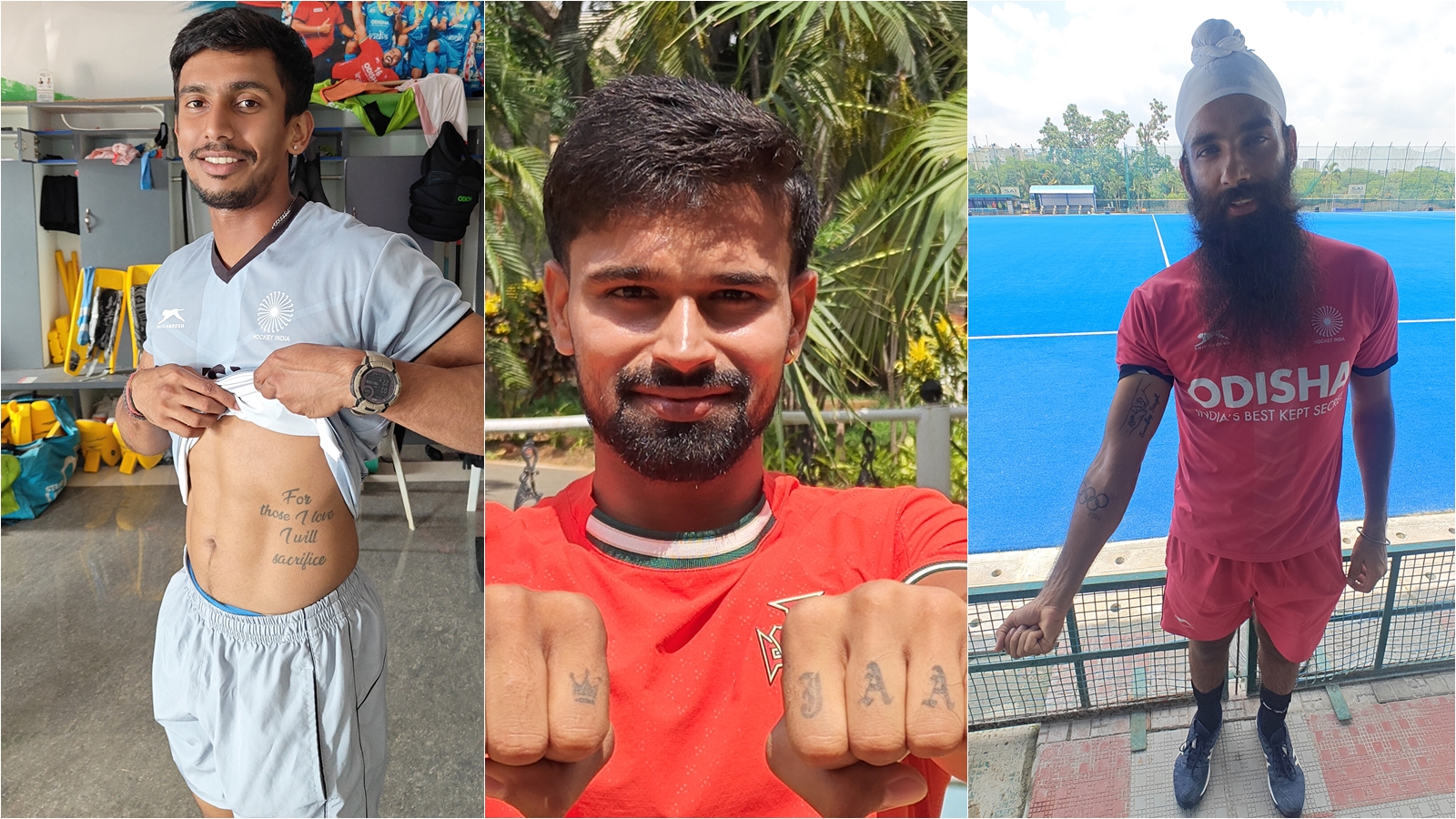
When under the cosh, Jarmanpreet Singh curls his biceps for strength. Abhishek Nain clenches his fist. Suraj Karkera taps his chest. It isn’t a physical flex. These are reminders. Each has a tattoo etched into the skin, carrying a story of its own – of family, faith, struggle, or simply the person they want to be. As India head into the hockey World Cup this weekend, facing Wales in the opener on Saturday, there will be plenty of talk about tactics, form and the players expected to deliver when the
. Suraj Karkera taps his chest.
It isn’t a physical flex. These are reminders. Each has a tattoo etched into the skin, carrying a story of its own – of family, faith, struggle, or simply the person they want to be.
As India head into the hockey World Cup this weekend, facing Wales in the opener on Saturday, there will be plenty of talk about tactics, form and the players expected to deliver when the pressure is at its highest. But beneath the jerseys, some carry something more personal – little reminders inked into their skin of where they come from, what they believe in and, sometimes, who they believe they are.
“When I am low, feeling a little down, I look at my tattoo and get confidence from it,” says Abhishek. One of India’s fiercest strikers and a constant, reliable source of field goals, he has a crown inked on his knuckles — a reminder, when the chips are down, that he is the “king of the ‘D’”.
On the left knuckles, he has the word ‘Jaat’ inscribed in calligraphy. “It fills me with confidence. Makes me feel tough,” he says. “Haryanvi Jaats are mentally very tough. We walk the talk. There’s this inherent zid. So whenever I look at this, I’m reminded of that.”
The tattoos aren’t merely for decoration. Each one of them tells a story. For Manpreet Singh, India’s most-capped player, the ‘Ik Onkar’ on his arm is an expression of faith. The incomplete Olympic rings on Hardik Singh, arguably India’s most influential player on the field, represent an ambition still unfinished. The top part of the centre ring, he says, will be completed after “winning the gold medal at the Los Angeles Olympics in 2028”.
Underneath the bulky goalkeeper kit, Karkera wears the words: ‘For those I love, I will sacrifice.’ It signifies ‘deep loyalty’. “It’s about putting the loved ones before myself. I also serve in the Army, so (loyalty is natural),” says Subedar Karkera.
Few tattoos, however, carry a deeper, more personal resonance than Jarmanpreet’s. On his right forearm, Jarmanpreet has the Olympic rings – customary, if you are an India player – and the name of his daughter, Jind. “She was born in the morning, and I was named in the squad later that evening,” Jarmanpreet says.
But it is the tattoo on his biceps that carries the story of his struggle. The wingback – whose darting runs down the right launch many an Indian attack – has an elegant fist bump. It’s a tribute to his younger brother Sandeep Singh, who was Jarmanpreet’s ‘right-hand man’ during the most ‘difficult phase of his career’.
During the 2015 Hockey India League, Jarmanpreet flunked a dope test after his sample returned positive for a banned drug, 19-norandrosterone, a metabolite of nandrolone. It entered his body, the player has argued in the past, after taking a painkiller injection from a local doctor in his village in Punjab.
Jarmanpreet was only 19 back at the time. A product of Jalandhar’s famous Surjit Singh Academy, he was in contention for a spot on the team for the 2016 Junior World Cup that India won. However, the failed dope test led to a two-year ban, threatening to derail a promising career.
Sandeep ensured his elder brother didn’t go off the rails. “Because of the ban, I could not practice with any team or play any tournament. I couldn’t be around a domestic team, either. So, I had to practice alone,” Jarmanpreet says. “My brother stood by me. He is a hockey player, too. After his training, he would ensure I could do mine. Whether it was a hot afternoon or cold evening. Weekday or Weekend. No matter what it was, he made sure I had a training session at least once a day.”
Soon after he served his ban, Jarmanpreet was picked for India. Soon after rejoining the team, he paid a touching tribute to his brother with the tattoo. “I believe that if there is a bad time in the life of a player or any person for that matter, then he has to face everything alone,” Jarmanpreet says. “But there should be someone in your life who pushes you whenever you fall or feel low. For me, that person was Sandeep. He now lives in Canada and plays hockey there. But he continues to help me.”
For him, like the rest of the team, the tattoo isn’t merely a decoration. It is a window into the people behind the players India will need when the World Cup begins: the striker who draws strength from his identity, the midfielder chasing an unfinished dream, the goalkeeper driven by loyalty and the defender who remembers the brother who helped him through his darkest days.
When the pressure builds, and the stakes rise, these are the stories that sit beneath the jerseys, carrying the men who wear them.
Over the course of a 18-year-long career, Mihir Vasavda has covered 2010 FIFA World Cup; the London 2012, Tokyo 2020 and Paris 2024 Olympic Games; Asian Games in 2014 and 2022; Commonwealth Games in 2010 and 2018; Hockey World Cups in 2018 and 2023 and the 2023 ODI Cricket World Cup. ... Read More