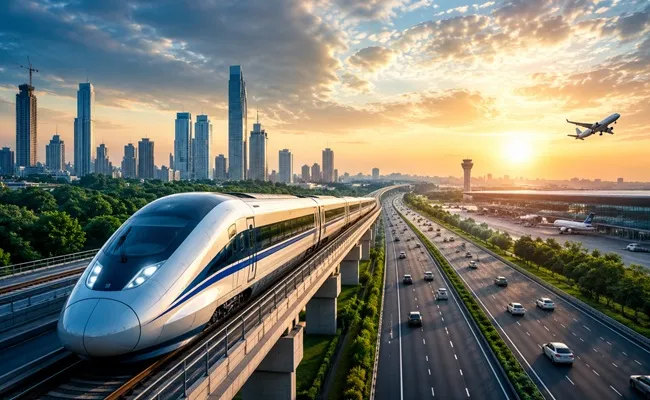
Indian politicians and governments often celebrate the construction of airports as if the runway itself is proof of development. But an airport is only infrastructure. Its real value lies in how effectively it connects people, businesses, cities and markets. Developed countries do not usually treat every airport inauguration as a major political achievement. The real question is not how many airports are built, but how many people actually use them and how much economic activity they generate. Recent developments in Uttar Pradesh offer an important lesson. Six airports, including Kushinagar,
. Its real value lies in how effectively it connects people, businesses, cities and markets.
Developed countries do not usually treat every airport inauguration as a major political achievement. The real question is not how many airports are built, but how many people actually use them and how much economic activity they generate.
Recent developments in Uttar Pradesh offer an important lesson. Six airports, including Kushinagar, Azamgarh, Chitrakoot, Shravasti, Moradabad and Aligarh, currently have no scheduled commercial flights. The government has cited reasons such as low passenger demand, airline decisions, aircraft shortages and the end of viability-gap support.
Kushinagar is a striking example. After a high-profile inauguration in 2021, scheduled services gradually disappeared. November 2023 was the last month with regular commercial flights, and the airport reportedly had no scheduled services during 2024 and 2025.
This does not mean airports should not be built. They should. But planning must begin with demand, connectivity, economic potential and long-term viability, rather than inauguration ceremonies and political headlines.
The bigger question is why India is not thinking more aggressively about transformative rail infrastructure.
China has spent decades building a massive high-speed rail network. By the end of 2025, its high-speed rail network had reportedly reached around 50,400 km.
China’s latest CR450 prototype is designed for an operational speed of 400 kmph, with testing reaching 450 kmph. Experimental maglev projects are also exploring much higher speeds, including laboratory tests at around 800 kmph.
India should be asking what a similar long-term national rail vision could achieve.
A genuine high-speed north-south corridor connecting cities such as Delhi, Hyderabad, Vijayawada and Chennai could transform travel, business and regional development.
Instead, India still celebrates Vande Bharat trains operating on conventional railway infrastructure at much lower speeds. Vande Bharat is certainly a welcome improvement, but the ambition should go much further. Modernisation cannot stop with making existing systems slightly faster.
Road infrastructure also needs a more ambitious vision.
National highways have improved significantly, but India still needs more controlled-access expressways that allow long-distance travel without repeatedly slowing down through towns, junctions and congested stretches.
The same thinking should enter our cities.
Hyderabad, for example, needs a stronger network of elevated and grade-separated corridors connecting distant parts of the metropolitan region. Strategic east-west, north-south and orbital routes could significantly reduce the hours people lose in traffic every day.
Infrastructure is not merely about concrete, steel and asphalt. It decides where businesses invest, where jobs are created, where housing develops and how quickly people can move.
The real estate boom around major transport corridors itself shows how strongly infrastructure shapes economic growth.
India therefore needs to move beyond simply counting airports, highways and railway stations.
The real measures of development should be travel time reduced, productivity improved, regions connected and economic opportunities created.
This should also become an important issue for Gen Z. The generation that will inherit India should demand infrastructure that matches the scale of the country’s population and ambitions, rather than projects that mainly produce impressive inauguration photographs.
India does not lack ambition. What it needs is sharper priorities.
Build airports where demand justifies them, but at the same time pursue world-class high-speed rail, expressways, urban corridors and integrated transport systems.
Development should ultimately be measured not by what politicians inaugurate, but by how quickly, efficiently and comfortably India moves.
Many NRIs, especially students and professionals on H-1B visas, should learn one important lesson before blindly supporting political parties on social media. Emotional attachment to…
Joseph C. Vijay, as the Chief Minister of Tamil Nadu, appears to be receiving considerable appreciation for the way his government has functioned during its…
What happened to a young medical professional riding a scooter should not be dismissed as an ordinary road accident. If the reported sequence of events…