God Doesnt Discriminate Madras High Court Gita Equal Temple Access
I
Indian ExpressVerified Publisher
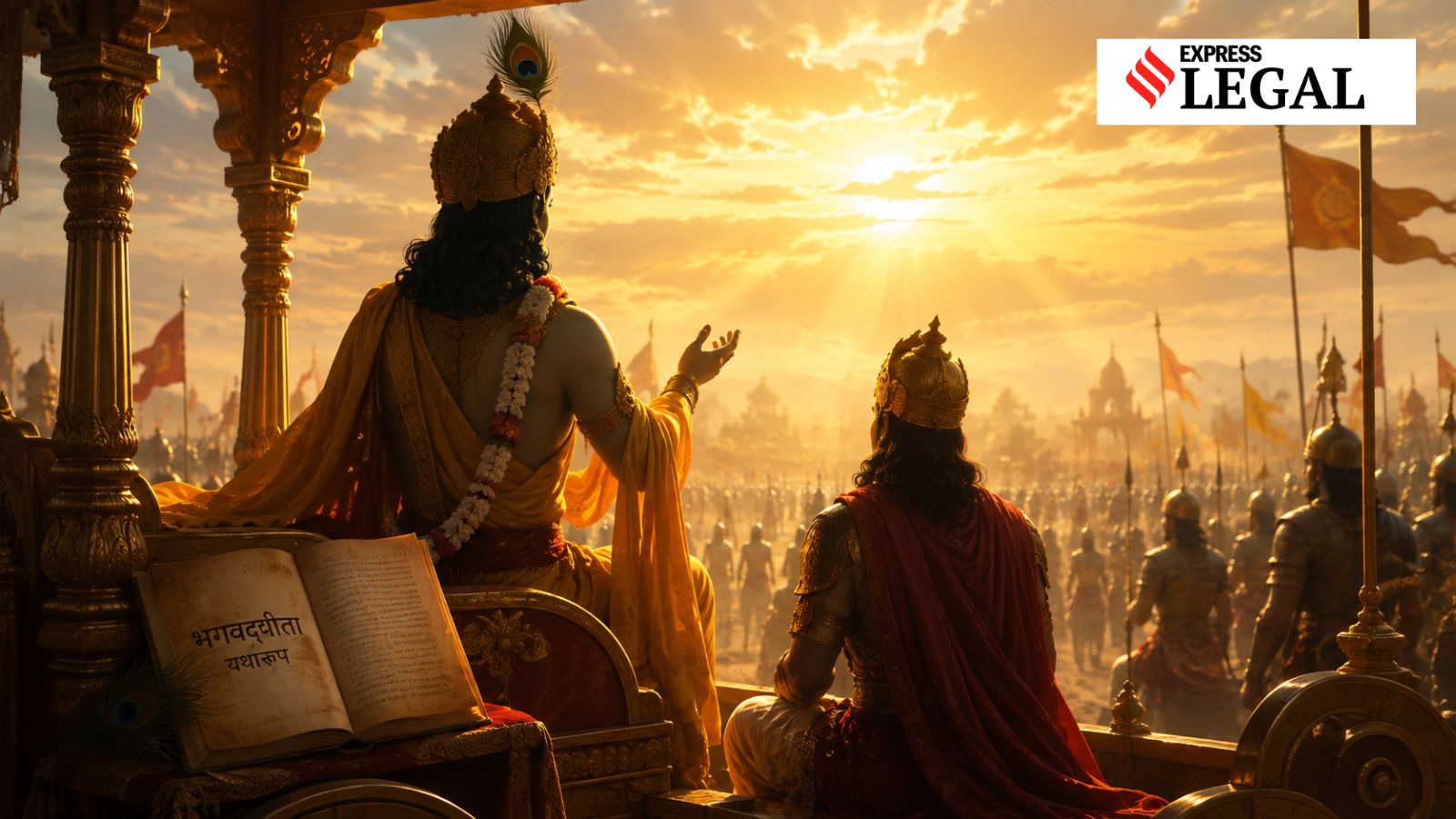
Quoting the Bhagavad Gita and Lord Krishna, the Madras High Court recently said that all living beings are equal in the eyes of God and that there is no room for discrimination in a place of worship while hearing a matter alleging that non-Brahmin devotees wer Quoting the Bhagavad Gita and Lord Krishna, the Madras High Court recently said that all living beings are equal in the eyes of God and that there is no room for discrimination in a place of worship...
Quoting the Bhagavad Gita and Lord Krishna, the Madras High Court recently said that all living beings are equal in the eyes of God and that there is no room for discrimination in a place of worship while hearing a matter alleging that non-Brahmin devotees were being treated differently during certain rituals at the temple.
Justices G Jayachandran and E Manoharan, while hearing the PIL, referred to Chapter 9, Verse 29 of the Bhagavad Gita, which says: “I am equally disposed to all living beings. I am neither partial to anyone nor do I hate anyone. But those who worship Me with devotion, they are in Me and I am in them.”
The high court, however, recorded the submission of the temple authorities that there would be no discrimination against any section of devotees, including non-Brahmins, in any temple rituals.
“In the eyes of God, all living beings are equal and God does not discriminate. Having said that, it is to be noted that the Hon’ble Courts have also held that there is no room for discrimination in a place of worship,” the August 17 order read.
The man submitted that he is a devotee of Lord Devarajaswamy at Kancheepuram and he is a Thenkalai Vaishnavite and that this tradition is accepted in the Devasthanam (temple). He added that the said Devasthanam has many shrines and the devotees from all communities worship the deities.
He alleged that the Sri Manavala Mamunigal shrine has two entrances, one main entrance and one side entrance, and that non-Brahmin devotees were allegedly asked to use the side entrance, while Brahmin devotees were permitted to use the main entrance. He added that this is discrimination against non-Brahmins.
He also alleged that non-Brahmin devotees were not permitted to recite hymns in all the shrines and were required to remain outside the shrine while receiving Prasadam and Theertham. He claimed that the non-Brahmins were also discriminated against during certain rituals.
He stated that he made representations to the authorities in this regard and they have responded that there should not be any discrimination and that if there is any discrimination in the name of temple custom, strict action will be taken. The petitioner claimed that he has filed this PIL to prohibit discrimination against non-Brahmins in the Arulmigu Devaraja Swamigal Temple in Kanchipuram.
The man was represented by advocates S Shanmugasundaram and S Senthilnathan, who argued that non-Brahmins are not given permission to recite the hymns in all the shrines of Devarajaswamy Temple. The lawyer added that non-Brahmins are made to stand outside the shrine, where they will get Prasadham and Theertham, and face discrimination in other temple rituals.
Special Government Pleader R Bharanidharan argued that it is practically impossible to allow the public inside the sub-shrines, which are small structures. It was added that the temple reciters or scholars themselves are not able to be fully accommodated inside the sub-shrines and, because of this, members of the public are not able to be accommodated inside and therefore have to be accommodated only outside the sub-shrines during the service periods.
He further submitted that the temple administration will not discriminate against any portion of the public in the matter of temple practices and that all members of the public are treated equally.
The court noted that the man has no intention to disrupt any of the traditional rituals that are performed in praise of the deity, as he himself has stated that he worships Lord Devarajaswamy. It added that if the current arrangement, as explained by the Special Government Pleader, where the petitioner will also get his chance to recite the hymns in the shrines, is preserved and in this way, then there is no discrimination occurring by following any tradition.
Concerning the issue of the recital of the hymns and Pradandham, the court noted that the statement of the authorities concerned suggest that the that apart from the Adhyabaga Misari, which is a right secured and conferred for the Thenkalai Sect and an important service offered during certain rituals, the petitioner nor any other person or any group will be prevented recital in any shrines of the temple for their worship.
“This effectively will also resolve the other grievance of the petitioner that non-Brahmins are not permitted to recite the hymns in the shrine,” it added.
With these assurances and undertakings on record, the court disposed of the PIL without issuing any further directions.
Richa Sahay is a Legal Correspondent for The Indian Express (Digital), where she focuses on simplifying the complexities of the Indian judicial system. A law postgraduate, she leverages her advanced legal education to bridge the gap between technical court rulings and public understanding, ensuring that readers stay informed about the rapidly evolving legal landscape. Expertise Advanced Legal Education: As a law postgraduate, Richa possesses the academic depth required to interpret intricate statutes and constitutional nuances. Her background allows her to provide more than just summaries; she offers context-driven analysis of how legal changes impact the average citizen. Specialized Beat: She operates at the intersection of law and public policy, focusing on: Judicial Updates: Providing timely reports on orders from the Supreme Court of India and various High Courts. Legal Simplification: Translating dense "legalese" into accessible, engaging narratives without sacrificing factual accuracy. Legislative Changes: Monitoring new bills, amendments, and regulatory shifts that shape Indian society. ... Read More