Colombia Earthquake Video Death Toll
I
Indian ExpressVerified Publisher
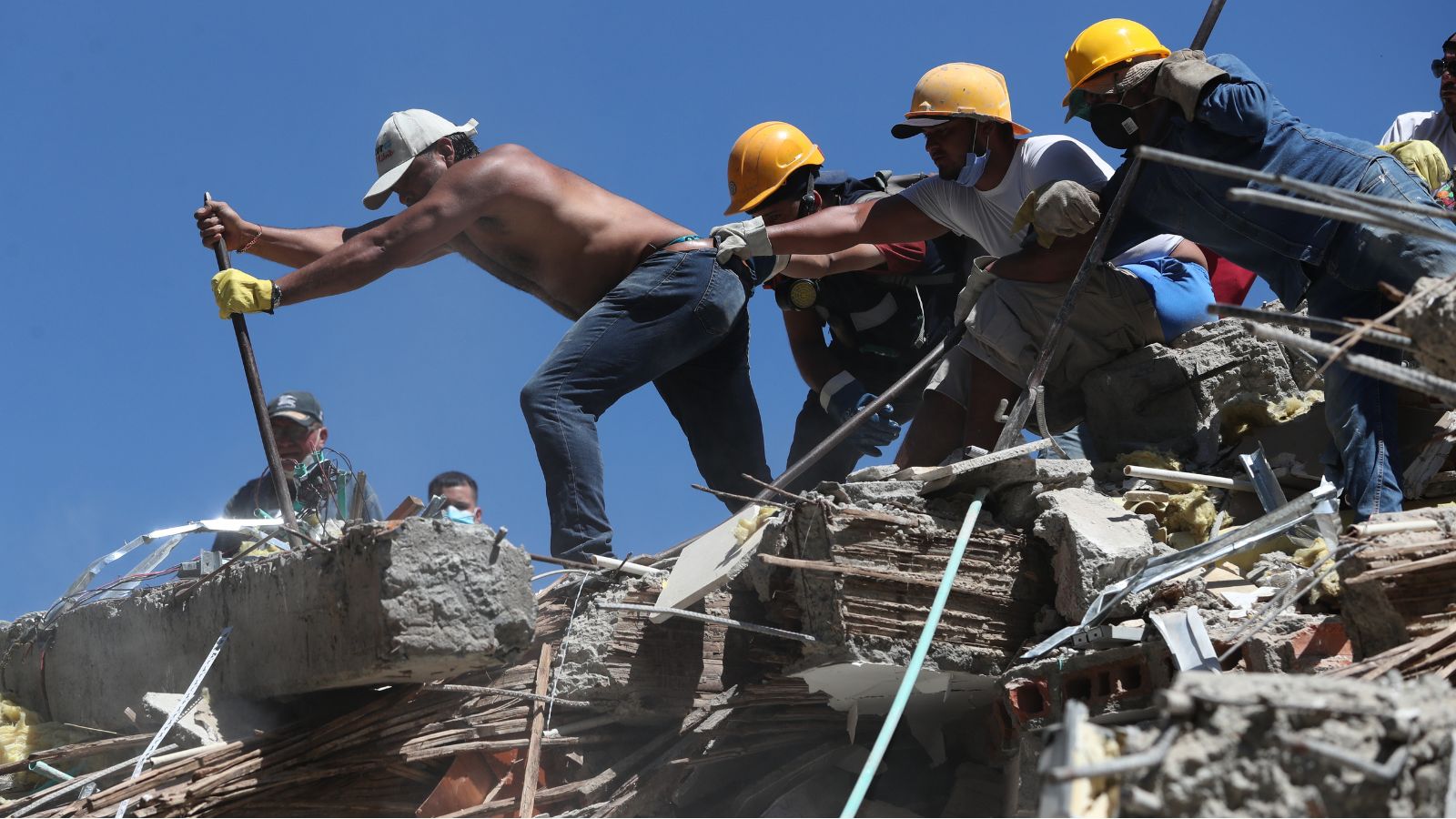
The earthquake that struck Colombia’s ‘Coffee Axis’ on Monday was one of the strongest in its history. The earthquake has, so far, claimed 132 lives. The impact of the earthquake was far reaching as it destroyed several structures. Videos from Colombia give us the scale of Monday’s earthquake, which has killed at least 132 people and injured more than 570. In Manizales, a tower on the city’s old cathedral is seen breaking apart and falling onto the street below, sending dust and stone across the road. In Cali, rescuers are
The earthquake that struck Colombia’s ‘Coffee Axis’ on Monday was one of the strongest in its history. The earthquake has, so far, claimed 132 lives. The impact of the earthquake was far reaching as it destroyed several structures.
Videos from Colombia give us the scale of Monday’s earthquake, which has killed at least 132 people and injured more than 570.
In Manizales, a tower on the city’s old cathedral is seen breaking apart and falling onto the street below, sending dust and stone across the road. In Cali, rescuers are filmed pulling a six-month-old baby and her mother from the rubble of a five-storey building. In Pereira, a four-storey building came down in the middle of the city.
For those who lived through it, the moment is still raw. Angélica Ávila, staying in a hotel in Manizales, told the BBC that people around her were screaming as cracks opened in the walls and dust poured from nearby buildings.
The 7.4 magnitude quake struck western Colombia on Monday morning and is the strongest the country has recorded this century. Officials say the number of dead is likely to rise further, as crews continue to dig through flattened buildings across several cities. Colombia’s Geological Service has warned that more aftershocks may follow. So far, the quake has produced 21 aftershocks.
But the damage was beyond the count of dead and injured. President de la Espriella said at least 1,575 homes, 18 health centres and 52 schools have been damaged, meaning displaced families, disrupted medical care, and children unable to return to class. Several airports have suspended flights, cutting off transport links just as they’re needed for aid and rescue crews. Curfews are in place in Pereira and Cali over fears of looting, adding a layer of fear on top of the physical damage.
The quake was centred near San José del Palmar, in the Chocó department, a region reached mostly by boat or plane. It hit at around 7.30 am local time and was felt in Bogotá, roughly 250 miles away, as well as in Ecuador, Venezuela and Panama.
Northwestern University seismologist Suzan van der Lee told Reuters that the quake’s depth would normally limit its impact, but its size and location still caused heavy shaking. She said, “At this magnitude, it did actually cause a lot of shaking.”
She added that Colombia sits where several tectonic plates meet, which makes it harder for scientists to study and predict earthquakes there. The area also lies along the Pacific “Ring of Fire,” the belt of fault lines that circles the Pacific Ocean and produces most of the world’s earthquakes.
President Abelardo de la Espriella said at least 1,575 homes, 18 health centres and 52 schools have been damaged. He said 61 buildings collapsed completely.
Pereira has reported the highest number of deaths, with local reports putting the figure between 40 and 60. A four-storey building came down in the city during the quake.
In Cali, video from Caracol Television, also shared on X, showed rescuers pulling a six-month-old baby and her mother from rubble after a five-storey building collapsed. Other footage showed part of a hospital falling onto ambulances parked outside, and rescue workers lowering people from hospital windows using ropes.
Support has come in from the United States and countries across Europe and Latin America. US Secretary of State Marco Rubio said Washington was closely watching the situation and stood ready to help. Ecuador, France, Mexico and Brazil have also offered support.
The disaster comes less than two months after two earthquakes struck northern Venezuela, killing more than 6,100 people.
The Express Global Desk at indianexpress.com which delivers authoritative, verified, and context-driven coverage of key international developments shaping global politics, policy, and migration trends. The desk focuses on stories with direct relevance for Indian and global audiences, combining breaking news with in-depth explainers and analysis. A major focus area of the desk is US immigration and visa policy, including developments related to student visas, work permits, permanent residency pathways, executive actions, and court rulings. The Global Desk also closely tracks Canada’s immigration, visa, and study policies, covering changes to study permits, post-study work options, permanent residence programmes, and regulatory updates affecting migrants and international students. All reporting from the Global Desk adheres to The Indian Express’ editorial standards, relying on official data, government notifications, court documents, and on-record sources. The desk prioritises clarity, accuracy, and accountability, ensuring readers can navigate complex global systems with confidence. Core Team The Express Global Desk is led by a team of experienced journalists and editors with deep expertise in international affairs and migration policy: Aniruddha Dhar – Senior Assistant Editor with extensive experience in global affairs, international politics, and editorial leadership. Nischai Vats – Deputy Copy Editor specialising in US politics, US visa and immigration policy, and policy-driven international coverage. Mashkoora Khan – Sub-editor focusing on global developments, with a strong emphasis on Canada visa, immigration, and study-related policy coverage. ... Read More