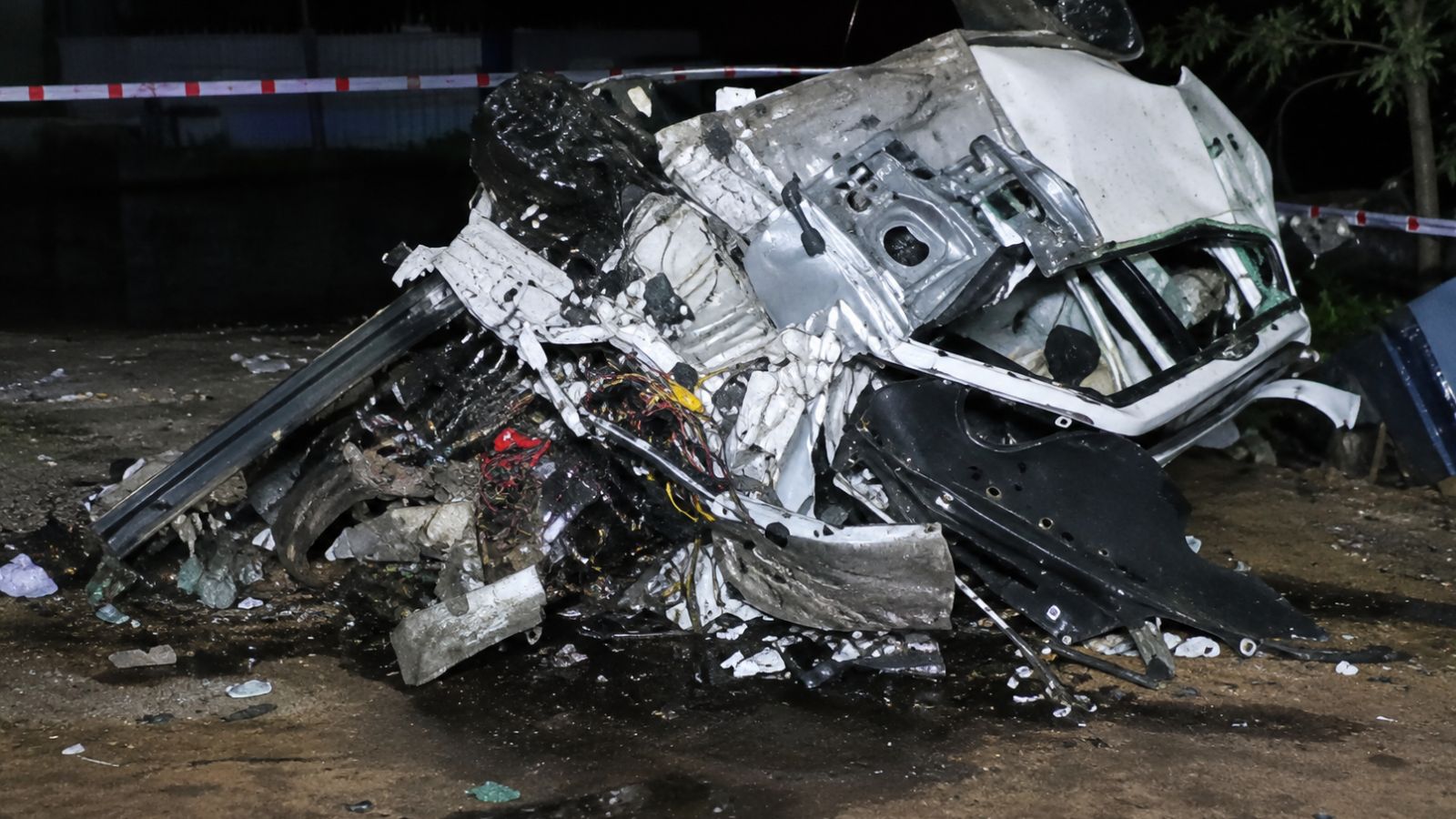
The blast was meant to be a warning, not a killing. A farmer in Karnataka s Bagalkot district allegedly used explosives to blow up the SUV of a liquor store owner who, along with his brother, was demanding repayment of a loan that had grown to Rs 67 lakh, the The blast was meant to be a warning, not a killing. A farmer in Karnataka s Bagalkot district allegedly used explosives to blow up the SUV of a liquor store owner who, along with his brother, was...
The blast was meant to be a warning, not a killing. A farmer in Karnataka’s Bagalkot district allegedly used explosives to blow up the SUV of a liquor store owner who, along with his brother, was demanding repayment of a loan that had grown to Rs 67 lakh, the police said.
According to police sources, the explosion in Jamkhandi, which reduced the Mahindra XUV 300 to a mangled heap and injured a passing motorcyclist, was allegedly carried out to intimidate the liquor store owner and his brother, who had lent the farmer Rs 40 lakh and were demanding repayment.
The blast took place around 10.45 pm on July 26 outside the Yuvaraj Wine Shop in Hipparagi village in the Jamkhandi area. The SUV belonged to Hanumantha Sanagond Athani, 35, who is the lessee of several liquor stores in Bagalkot.
According to the investigation, farmer Shivannand Basappa Jelli had borrowed Rs 40 lakh from Athani’s brother. With interest, the outstanding amount had risen to Rs 67 lakh, police sources said. The liquor store owner and his brother were allegedly demanding that Jelli repay the money or hand over four acres of his property.
The Bagalkot police suspect Jelli decided to intimidate them by targeting Athani’s vehicle.
They said Athani received a message from an unknown number on August 6, 10 days after the blast. The sender claimed responsibility for the explosion and warned that the next attack would be fatal, police sources said.
The message provided investigators with their first major lead. The police traced the handset used to send it to a second-hand phone purchased in Belagavi on August 2. They then analysed mobile tower data and CCTV footage from locations in Belagavi and Bagalkot, eventually identifying four suspects.
The four were arrested on Thursday at Hebbalapatti in neighbouring Vijayapura district.
According to the account given to police by Jelli, the main accused, he travelled to the liquor shop on a two-wheeler on the night of July 26. He allegedly avoided the CCTV cameras around the shop before placing explosives in a bag beneath Athani’s SUV.
He then allegedly used a capacitor connected to about 100 feet of wire to remotely trigger the blast, the police said.
Investigators recovered two mobile phones, capacitor wires, and gelatin sticks from the house of one of the accused.
The police said Jelli used “unused explosive material” from a borewell excavation in his farmland carried out two years ago. “The preliminary motive was to blast the car to warn against the repayment demands,” a police source said.
The explosion was powerful enough to topple the SUV, with debris scattered across a radius of around 40 metres. The blast occurred beneath the vehicle, towards the left side near the engine. The fuel tank did not explode, preventing a fire, the police said.
A passing motorcyclist, 22-year-old Yallaling Pujari, was injured in the blast. Athani was inside the liquor shop at the time, completing the day’s accounts.
After the blast, investigators found that the SUV had been parked under CCTV surveillance for more than six hours before the explosion. The footage did not initially show anything suspicious, the police said.
The Bagalkot police subsequently sought assistance from Mahindra & Mahindra, local mechanics and forensic experts to establish how the vehicle had been blown up.
Investigators then turned to the threat message sent to Athani on August 6. By combining the phone trail with tower-dump analysis and CCTV footage, they identified the suspects and tracked their movements to Vijayapura.
Police sources said the Bagalkot blast and the arrests in Vijayapura are not linked to the recent NIA investigation into an explosives supply network in the district.
The National Investigation Agency (NIA) arrested three Vijayapura-based explosives suppliers on August 7 in connection with the seizure of 89,600 explosive sticks and 10,500 gelatin tubes by the Kerala Police in February.
The explosives had been found in a truck parked at a firm in Malappuram. According to NIA, the Vijayapura suppliers, despite being licensed dealers, had sold the material in violation of legal requirements.
The agency subsequently arrested a man in Malappuram whom it identified as the alleged main conspirator in the illegal procurement of the explosives.