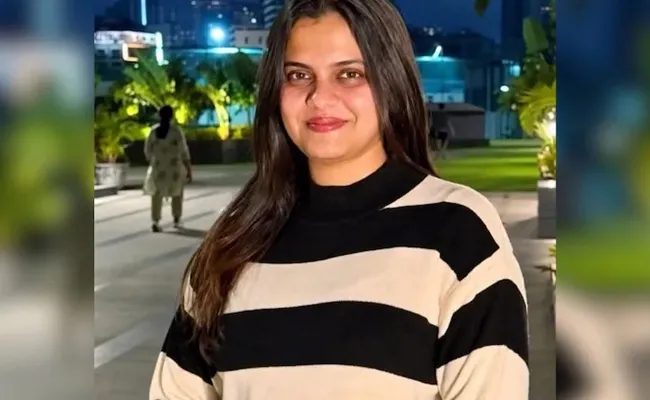
What happened to a young medical professional riding a scooter should not be dismissed as an ordinary road accident. If the reported sequence of events is correct that a drunken young man first hit her scooter from behind and then, after she objected or confro What happened to a young medical professional riding a scooter should not be dismissed as an ordinary road accident. If the reported sequence of events is correct that a drunken young man first hit...
What happened to a young medical professional riding a scooter should not be dismissed as an ordinary road accident.
If the reported sequence of events is correct — that a drunken young man first hit her scooter from behind and then, after she objected or confronted him, deliberately drove the car over her, causing catastrophic head injuries and brain death — then this is a deeply disturbing act of cruelty and recklessness.
She was not merely someone travelling on the road. She was a young doctor with a future ahead of her, dreams of becoming a specialist, and a family that had invested years of love, sacrifice and hope in her. In a few horrifying moments, those dreams were shattered.
A family that raised a daughter with dreams of becoming a physician and specialising in dermatology is now left with nothing but memories. Her parents may never again hear her voice, see her smile or watch her build the future they had imagined for her.
Yet, for the person behind the wheel, such an incident can sometimes become just another legal case — delayed by investigations, bail, influence and endless procedures.
What makes the incident even more disturbing is the allegation that the second act was deliberate.
A collision caused by drunken driving is already a serious offence. But if a person intentionally drives over an injured victim after a confrontation, it raises a far more troubling question about human values.
How can anger, alcohol and arrogance become so powerful that someone begins to treat another human life as though it has no value?
And then comes another serious question: Where is the accountability?
India does not lack laws. The country has traffic laws, criminal laws and penalties for drunken driving and for causing death through negligent or dangerous driving.
The deeper problem is often enforcement, consistency and accountability.
When people begin to believe that money, connections, political influence or social status can protect them from consequences, respect for the law begins to disappear.
The police have a responsibility to investigate such an incident thoroughly, preserve CCTV footage and other evidence, identify witnesses, establish whether the driver was intoxicated, reconstruct exactly what happened and ensure that appropriate criminal charges are pursued.
If the evidence establishes intentional conduct, the incident should not simply be treated as an ordinary traffic accident.
The justice system also has a responsibility to ensure that the case does not disappear into years of procedural delay.
The victim’s family should not have to fight endlessly just to make sure that their daughter’s case is taken seriously.
Equally troubling is the apparent lack of public attention.
If a young doctor can suffer such a horrifying fate and the incident receives little or no coverage, we must ask what has happened to our sense of outrage.
Does a person’s life become less important simply because the incident did not attract television cameras or social-media attention?
The media also has a responsibility. But responsible journalism must be based on verified facts, not sensationalism.
Serious incidents involving the death or brain death of a young professional deserve scrutiny when there are legitimate questions about intoxication, intentional driving, police response and accountability.
This is not about condemning an entire generation of Indian youth. Millions of young Indians are responsible, compassionate and law-abiding.
The problem is the dangerous culture that allows some young people to believe that drinking, speeding, displaying wealth, driving aggressively and confronting others on the road are signs of power or masculinity.
A car is not a weapon. But in the hands of a drunk and reckless driver, it can become one.
India has laws. What we desperately need is consistent enforcement of those laws.
No wealthy family, political connection, social status or personal influence should be allowed to change the value of an innocent person’s life.
The family of this young doctor deserves answers. The public deserves transparency. And the authorities owe society a proper investigation.
If these allegations are proven, justice must not be symbolic. It must be swift, impartial and proportionate to the gravity of the act.
A young doctor should have been preparing for her future, not fighting for her life because someone allegedly chose to drink, drive recklessly and respond to a confrontation with unimaginable violence.
Her life cannot be restored. But her tragedy must not be allowed to disappear in silence.
The least we can demand is truth, accountability and justice.
I attended Silicon Andhra’s Silver Jubilee celebrations, and one thought stayed with me throughout the event. It was a slap on the face of almost…
A growing debate is emerging over the level of trust Gen Z places in India’s public institutions. The discussion gained attention after Abhijeet Dipke of…
For years, the American Dream inspired thousands of Indian families. A degree from a top American university promised better jobs and a brighter future. Parents…