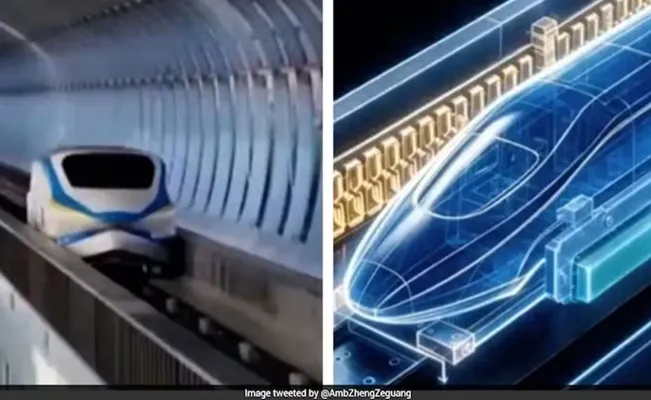
China has set another high-speed transport record after an experimental maglev train reached 800 kmph from a standstill in just 5.3 seconds. According to reports, the 1.1-tonne experimental vehicle completed the test on a 1-km track at the Donghu Laboratory in China has set another high-speed transport record after an experimental maglev train reached 800 kmph from a standstill in just 5.3 seconds. According to reports, the 1.1-tonne experimental vehicle...
China has set another high-speed transport record after an experimental maglev train reached 800 kmph from a standstill in just 5.3 seconds.
According to reports, the 1.1-tonne experimental vehicle completed the test on a 1-km track at the Donghu Laboratory in Hubei province.
However, this is not a passenger train. Researchers are using the vehicle to test advanced technologies that could later be used in areas such as aerospace, rocketry and other ultra-high-speed systems.
Maglev trains use magnetic forces to lift the vehicle slightly above the track, reducing friction and allowing it to move at extremely high speeds.
During the latest test, the train accelerated to 800 kmph in 5.3 seconds and was then brought to a controlled stop within about 200 metres.
The braking test was also considered important because travelling at such extreme speeds requires equally advanced systems to slow the vehicle safely.
The same experimental train had earlier reached around 650 kmph in seven seconds in June 2025. Researchers later pushed the speed to about 700 kmph and then 798 kmph while also improving acceleration time.
The tests have focused on technologies such as high-power energy delivery, electromagnetic propulsion, high-speed levitation control and emergency braking.
The speeds achieved are far higher than those of commercial high-speed trains currently in operation.
China’s fastest commercial high-speed trains operate at around 350 kmph, while existing maglev services generally run at much lower speeds than the latest experimental vehicle.
Researchers at China’s National University of Defence Technology are also working on similar ultra-high-speed maglev technology. One of their experimental vehicles reportedly reached 697 kmph in just two seconds.
Despite these impressive numbers, such trains are still far from being ready for passenger use.
Researchers are mainly studying whether the technology can be adapted for high-speed launch systems, rockets, fighter aircraft and future transport through low-pressure or vacuum tubes.
There are still several major challenges, including the cost of building long and precisely aligned tracks, ensuring stability, developing safe braking systems and protecting passengers at extreme speeds.
For now, the 800 kmph test is more about proving what the technology can do than about launching a new passenger train.
But it clearly shows how far China is pushing the limits of high-speed transport.
Until recently, many NRIs in the U.S. had several opportunities to pursue businesses alongside their regular jobs. Some worked full-time while also running IT consultancies.…
Oracle is reportedly preparing for another round of layoffs this month as the technology giant looks to reduce payroll costs while continuing to spend heavily…
A group of 30 US senators on Tuesdat urged the State Department to address delays in student and exchange visitor visas, warning that applicants may…
What is the use? Instead, China should kffer free welfare schemes for women to travel in eegular buses.
Hame educasan NAHI chahiye, hama haspatal NAHI chahiye, hame infra NAHI chahiye, hame chahiye carapsan, hama mandir chahiyee
Everyone will stun the world except us in india under the great leadership of our modiji laudena bhojyam. We still wondering how to cover the pothole caused by drizzle of rain let alone high speed trains. As long as we hold to fake hindutva our.country will never progress.
Progress under modijis law- de-na bhojyam govt.
beeda vadu high speed rail lo tiruguthada?
beeda vadiki cycle ivvali, cycle stands kattali
while we do tana tandana kula zeros worships and beg for jobs