
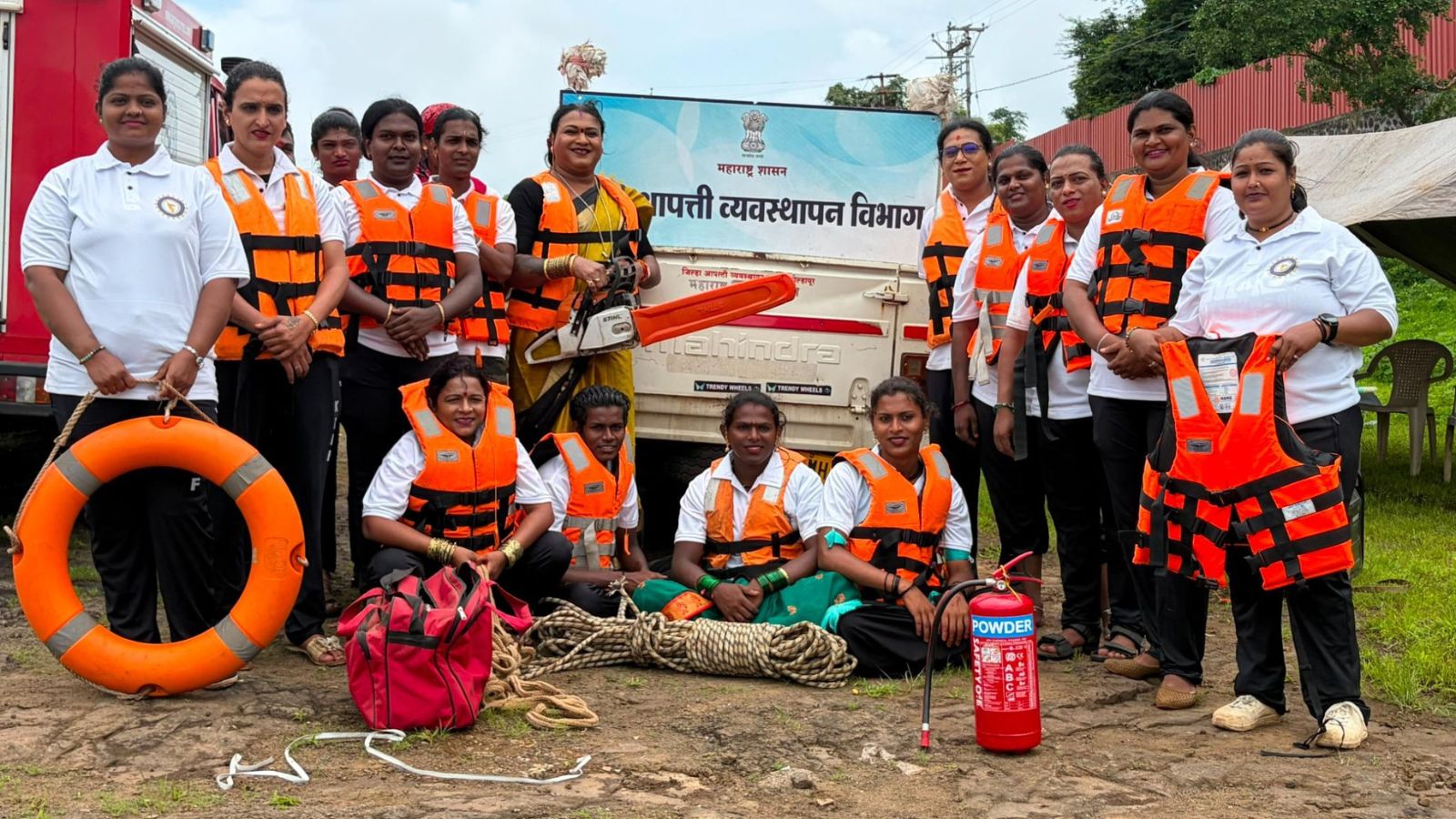
In the last week of August, a group of people gathered at Rajaram Lake, pulled on orange life jackets, checked their ropes, and spent 10 days practising rescue drills in the water. It looked like routine disaster-response training – until you learned who they were. This is India’s first transgender disaster management and rescue team, and for its members, the life jacket has come to mean something far bigger than safety gear.
The Kolhapur District Disaster Management Authority has trained over 2,500 volunteers in the last decade. In 2019, it created the state’s first all-women rescue unit, the ‘Aapda Sakhi’ team, which now counts more than 500 trained volunteers. But ahead of this year’s monsoon, officials decided to try something unique.
“We thought, why not train a transwomen team,” said Prasad Sankpal, District Disaster Management Officer, Kolhapur. “So a first-of-its-kind transgender disaster management and rescue team initiative was begun in the country.”
The first batch of 10 transwomen, all associated with the Kolhapur-based Maitri NGO, went through their inaugural training module from May 26 to 28. Since then, the district has trained 15 transwomen in total, with fresh rounds of practice held Every three months – the most recent a 10-day exercise at Rajaram Lake in the last week of August.
Recruits learned rescue swimming, How To operate an inflatable rescue boat, dry and wet lifesaving techniques, motorboat handling and maintenance, and First Aid and CPR.
“So far the results are excellent,” Sankpal said. “The institutional strengthening is already visible – the volunteers now help victims of road accidents without any instructions.”
For the women themselves, the initiative is about something the training manual doesn’t cover.
“Even today, people see us as sex workers or beggars,” said Mayuri Alvekar, founder of Maitri NGO, who brought the other volunteers on board. “I believe that such opportunities of working with the administration would help promote inclusivity and give us space in mainstream society, while changing the perspective towards us. We have been helping people during disasters or rescue needs but faced discrimination. However, now we are getting recognition and, most importantly, an identity.”
“To take the initiative further, I have also created a similar volunteer team in Dhule and Parbhani,” Alvekar added.
Suhasini Devmane, another team member and Maharashtra’s first transgender tourist guide, spent eight years as an ayurvedic panchakarma expert while hiding who she was.
“Despite a desire to contribute to society, many of us had previously been unable to participate in social initiatives due to a lack of opportunities,” she said. “For over eight years, I had to hide my identity – else I would have lost my job, and my financial situation didn’t allow for that risk then. I believe this training will not only change society’s perspective towards transgender people but also boost the self-confidence of individuals within the community.”
Shivani Gajabar, who is currently pursuing a Master of Social Work degree at Shivaji University, Kolhapur, says the acceptance hasn’t fully arrived yet.
“Even today, transgender community members feel alienated from mainstream society,” she said. “Though giving us a platform in the disaster management rescue team is a welcome step and would help bring inclusivity – and we all would give our best while saving lives – I feel there is a long way ahead to fill the gap. Even when I go regularly to attend classes, no one sits on my bench. I’m all alone.”
Her family cut off contact when she left home in Class 7. “They used to think I could not do any considerable work,” she said. “However, now, being part of the disaster management rescue team, my family members have started communicating with me again.”
The administration isn’t stopping at floods and drowning rescues. “There are around 30 categories of man-made and natural disasters, including wildlife rescues involving snakes and crocodiles in Kolhapur, and the transwomen volunteers will gradually be trained for these as well,” Sankpal said.