
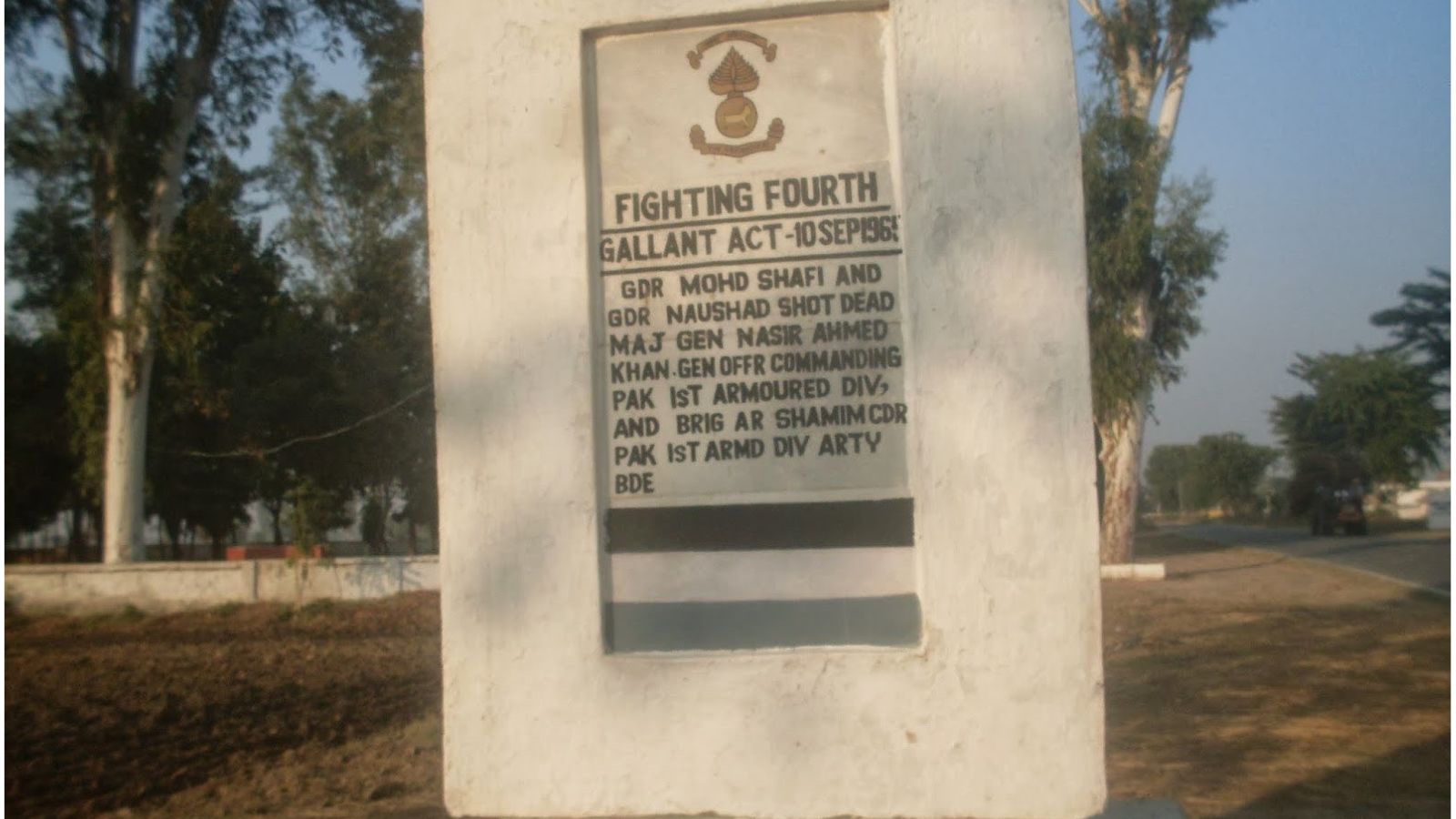
On the Amritsar-Khemkaran road, just outside Chima village in Punjab’s Tarn Taran district, there is a memorial to the gallant action of the troops of 4 Grenadiers who helped blunt the Pakistani armoured offensive in the Battle of Asal Uttar in the 1965 war.
Each September, well-deserved homages are paid to these brave grenadiers who laid down their lives, especially Company Quarter Master Havildar Abdul Hamid of the battalion, who was awarded the Param Vir Chakra. Special mention is also made of the battalion’s action in which Pakistani artillery commander Brig A R Shami was killed. However, a mention is also made of the killing of Maj Gen Naseer Ahmad Khan, the general officer commanding (GOC) of Pakistan’s 1 Armoured Division, in the same incident even though there is scant evidence of it.
Various accounts written by Indian and Pakistani army officers have shed enough light on What happened on that fateful day of September 10, 1965, yet a misconception prevails about the chain of events.
A Pakistani brigadier’s death
In his book, The Way it Was: Inside the Pakistan Army , Brig Z A Khan, a cavalry officer, writes that Brig Shami and Brig Bashir Ahmed, commander of the 5 Armoured Brigade, were tasked by the chief of the general staff of the Pakistani Army on Sept 10 to advance and reconnoitre because he was upset over the lack of progress of the 1 Armoured Division. He decided that Chima should be captured by the 24 Cavalry and 5 Frontier Force regiments.
To put this into effect, the commander of the 5 Armoured Brigade, the divisional artillery commander, and the officer commanding the SP Field Regiment supporting the brigade moved forward on the Khem-Kharan-Bhikkiwind Road. They were ambushed, and Brigadier Shami, the divisional artillery commander, was killed. The reserve squadron of the 24 Cavalry regiment tried to clear the ambush site but, without infantry, could not do so.
The news of the ambush spread and the troops started moving back, bringing the operations to a standstill. “The GOC 1 Armoured Division, while moving through Khem Karan, ordered 1 FF to clear the town and it was finally done,” writes Brig Khan.
From this account, it is clear that the GOC was still alive and in action on the day Brig Shami got killed. Earlier, on September 9, Lt Colonel Sahibzada Gul, commanding officer of the 6 Lancers regiment, was shot dead near Valtoha while standing on the turret of his tank and observing the Indian positions. Major I B Khan, the second-in-command, refused to assume command and none of the squadron commanders rose to the occasion. “6 Lancers became paralysed. 24 Cavalry advanced to Bhure Kuhna, there. Under Indian shelling, the commanding officer collapsed and this regiment also went out of control,” says Brig Khan.
Radio message that fuelled the misconception
The killing of Lt Colonel Gul or Brigadier Bashir could explain the radio message intercepted by Indian troops the following day, which said “Bara Imam Mara Gaya (senior officer has been killed)”. Since the shoot-up of Brig Shami and Brig Bashir had happened the same day, it may have been supposed that the GOC of the 1 Armoured Division was also conducting a reconnaissance and was among those killed or fatally wounded.
There is also the eyewitness account of the reserve squadron commander of the 24 Cavalry regiment, Maj (later Colonel) Samiuddin. He had advanced close to Asal Uttar and was observing the episode of Brig Shami fetching up in a jeep on the road to Bhikhiwind in a gung-ho manner.
In a podcast with Pakistani military historian Major Agha Amin, Colonel Samiuddin said that Brig Shami took Brig Bashir along with him, asking why the troops were not advancing despite there being nothing in front of them. Maj Sami says the shoot-up happened beyond his eyesight but added that Brig Bashir managed to escape with minor injuries. He said he got the brigade commander put on one of his tanks and taken to the rear at Khem Karan.
Brig Z A Khan also mentions that the GOC of the I Armoured Division and the commanders of the 4 and 5 Armoured Brigades were relieved of their commands on September 11 and most of their staff officers were transferred. The Pakistani accounts, thus, state that not only was the Pakistani GOC giving fresh orders on September 11, a day after being allegedly shot dead or fatally injured in battle, but he was also dismissed from command the same day.
Major General (retd) V K Singh, who has written a history of the Corps of Signals, has mentioned the version of events of the day as narrated by Major Naresh Rastogi, officer commanding of the 7 Brigade Signal Company, on September 9 and 10. Major Rastogi says that it was learnt on September 10 that the Pakistani commanders expected the road to Delhi to be clear and were advancing in jeeps, protected by armour, to reach Harike.
Major Rastogi further recounts that the same evening Radio Pakistan announced the decoration of Hilal-e-Jurrat for their GOC. He adds that Brig Shami was killed and his jeep with his body was captured along with their operations order and fully marked artillery map. “The body of another commander, perhaps the armoured brigade commander, had been taken away,” he says.